Anti-ageing skincare can feel like navigating a foreign language. Retinol here, peptides there, vitamin C on the label of seemingly everything — but what do these ingredients actually do to your skin? Understanding the science behind these actives isn’t just for dermatologists or beauty editors. Once you know how each ingredient works, choosing products becomes far less overwhelming and a lot more intentional.
This guide breaks down the most well-researched, scientifically supported active ingredients found in anti-ageing skincare — what they do, how they work, and who they’re best suited for.
What Makes an Ingredient “Active” in Skincare?
Before diving into the individual ingredients, it’s worth clarifying what “active” actually means in this context. In skincare, an active ingredient is one that has been shown to produce a measurable, physiological change in the skin. These are the ingredients doing the heavy lifting — not just sitting on the surface, but penetrating deep enough to influence how skin cells behave.
This is distinct from excipients or base ingredients (like certain emollients and preservatives), which help a formula feel good or stay stable, but don’t directly alter skin function. Actives are typically what you’ll see highlighted on packaging, and they’re the reason some products genuinely work and others don’t.
It’s also worth noting the 1% rule in skincare — a common reference to the fact that ingredients listed after the 1% threshold on an INCI list can appear in any order. This matters because some brands list impressive-sounding actives near the bottom of an ingredient list, where their concentration may be so low as to have minimal effect. Knowing this helps you read labels more critically.
Retinoids: The Gold Standard of Anti-Ageing
If there’s one ingredient that consistently earns the title of best active ingredient for anti-ageing, it’s retinoids — the umbrella term for vitamin A derivatives. This category includes retinol (available over the counter), retinaldehyde, and prescription-strength tretinoin.
Retinoids work by binding to retinoic acid receptors in skin cells, which triggers a cascade of beneficial changes:
- Speeding up cell turnover, which helps fade pigmentation and smooth texture
- Stimulating collagen and elastin production in the dermis
- Reducing the appearance of fine lines and wrinkles over time
- Regulating sebum production, which can also help with adult acne
Research published in scientific literature consistently shows that tretinoin (the prescription form) can produce visible improvements in fine lines, skin tone, and firmness with regular use over several months. Over-the-counter retinol is gentler and works more gradually, converting to retinoic acid once absorbed by the skin.
The main drawback? Retinoids can cause initial irritation, redness, and peeling — especially when you first introduce them. Starting with a lower concentration (0.025%–0.05%) a few times per week and building up slowly tends to minimise these effects. They’re also photosensitising, so applying them at night and wearing SPF during the day is essential.
Retinaldehyde: The Middle Ground
Retinaldehyde (sometimes listed as retinal) sits between retinol and tretinoin in terms of potency. It only requires one conversion step to become retinoic acid (compared to retinol’s two), making it more effective than retinol but generally better tolerated than prescription options. It’s a good option for those who find retinol underwhelming but aren’t ready for a prescription.
Vitamin C: Brightening, Protecting, and Firming
Vitamin C — specifically L-ascorbic acid — is one of the most studied antioxidants in skincare. It works on multiple levels simultaneously, which is part of why it’s so widely used in anti-ageing formulations.
Its key functions include:
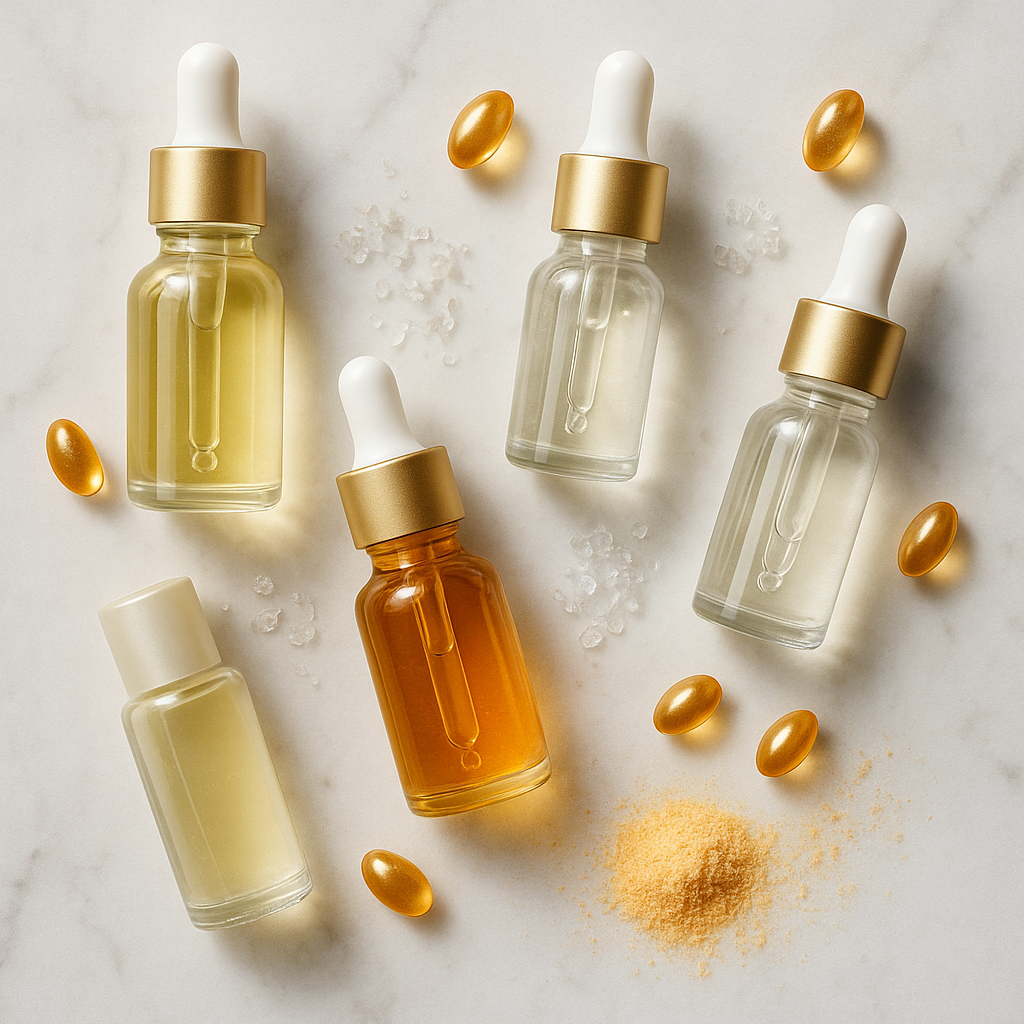
- Antioxidant protection: Vitamin C neutralises free radicals generated by UV exposure and pollution, helping to prevent oxidative damage that accelerates ageing
- Collagen synthesis: It’s an essential cofactor in the production of collagen, meaning the skin genuinely cannot build new collagen without it
- Brightening: It inhibits the enzyme tyrosinase, which is responsible for melanin production, helping to fade dark spots and even out skin tone
Vitamin C is most effective at a concentration of 10–20% and at a low pH (around 3.5). The downside is its instability — L-ascorbic acid oxidises quickly when exposed to air and light, turning products yellow or orange and losing potency. Stabilised derivatives like ascorbyl glucoside or sodium ascorbyl phosphate are more shelf-stable, though generally considered slightly less potent.
Using vitamin C in the morning, underneath SPF, maximises its protective benefits throughout the day.
Peptides: Sending Signals to Skin Cells
Peptides are short chains of amino acids — essentially the building blocks of proteins like collagen, elastin, and keratin. In skincare, they function as cell-communicating ingredients, sending signals to skin cells that encourage them to behave in more youthful ways.
Different types of peptides target different concerns:
- Signal peptides (such as Matrixyl/palmitoyl pentapeptide-4): Stimulate collagen and elastin production
- Carrier peptides (such as copper peptides): Deliver trace elements to the skin that support wound healing and collagen formation
- Neurotransmitter-inhibiting peptides (such as Argireline/acetyl hexapeptide-3): Reduce muscle contractions, similar in concept to botulinum toxin, to soften expression lines
Peptides are generally very well tolerated — they’re suitable for sensitive skin, those who cannot use retinoids, and as a complement to other actives. They tend to work gradually and are best used consistently in serums or moisturisers over the long term.
AHAs and BHAs: Exfoliating for Renewal
Chemical exfoliants are a cornerstone of anti-ageing routines. Rather than physically scrubbing the skin, they dissolve the bonds between dead skin cells, encouraging faster cell turnover and revealing fresher skin beneath.
Alpha Hydroxy Acids (AHAs)
AHAs — which include glycolic acid, lactic acid, and mandelic acid — are water-soluble acids derived primarily from natural sources. Glycolic acid, with the smallest molecular size, penetrates most deeply and is the most studied. Regular use can:
- Smooth fine lines and improve skin texture
- Fade hyperpigmentation and sun damage
- Improve the efficacy of other actives by clearing the path through dead skin cells
Lactic acid is a gentler option with the added benefit of being a humectant — it attracts moisture as well as exfoliating. Mandelic acid, with a larger molecular size, is ideal for sensitive or darker skin tones as it penetrates more slowly and carries a lower risk of post-inflammatory hyperpigmentation.
Beta Hydroxy Acids (BHAs)
The most common BHA in skincare is salicylic acid. Being oil-soluble, it can penetrate into pores to clear congestion — making it especially useful for those with oily or acne-prone skin. While less directly focused on anti-ageing than AHAs, its ability to keep pores clear and refine skin texture contributes meaningfully to a smoother, more even complexion.
Niacinamide: The Multitasker
Niacinamide (vitamin B3) has earned something of a cult status in recent years — and for good reason. It’s one of the most versatile and well-tolerated actives available, with a strong evidence base across multiple skin concerns.
In the context of anti-ageing specifically, niacinamide:
- Boosts ceramide production, strengthening the skin barrier and reducing moisture loss
- Reduces the appearance of enlarged pores and uneven skin tone
- Inhibits the transfer of melanin to skin cells, helping to fade dark spots
- Has anti-inflammatory properties, making it useful for reactive or sensitised skin
- Supports collagen production, contributing to firmer-looking skin over time
Concentrations of 2–5% are effective for most benefits, while higher concentrations (up to 10%) are used for more targeted pigmentation concerns. Niacinamide plays well with most other actives — including retinol and vitamin C — making it easy to incorporate into an existing routine.
Hyaluronic Acid: Hydration That Supports Skin Structure
Hyaluronic acid (HA) is a naturally occurring molecule in the body that can hold up to 1,000 times its own weight in water. As we age, natural HA levels in the skin decline, contributing to dryness, loss of plumpness, and the appearance of fine lines.
Topical HA works primarily as a humectant, drawing moisture from the environment and deeper layers of skin to the surface. This doesn’t reverse ageing at a cellular level, but it does significantly improve the appearance of dehydrated skin and creates a more favourable environment for other actives to work effectively.
HA comes in different molecular weights, and the best formulations include multiple sizes — larger molecules hydrate the surface, while smaller fragments (low molecular weight HA) can penetrate more deeply. It’s an ingredient almost universally suited to every skin type and concern.
SPF: The Most Important Anti-Ageing Active of All
Technically, sun protection factor (SPF) isn’t classified the same way as the ingredients above — but no discussion of anti-ageing actives is complete without it. Photoageing, caused by cumulative UV exposure, is estimated to account for around 80–90% of visible skin ageing. Fine lines, dark spots, loss of elasticity, and uneven texture are all significantly accelerated by sun exposure.
Daily broad-spectrum SPF 30 or higher is the single most evidence-backed anti-ageing intervention available without a prescription. No retinol or vitamin C can fully compensate for unprotected sun exposure, which is why SPF is considered the non-negotiable foundation of any effective anti-ageing routine.
Mixing Actives: What Works Together and What Doesn’t
One of the most common questions is which active ingredients shouldn’t be used together. While individual skin tolerance varies, some general guidance applies:
- Retinoids + AHAs/BHAs: Both are potent and can be irritating — using them simultaneously increases the risk of over-exfoliation. Alternating nights is a common approach.
- Vitamin C + Retinol: These work well when separated by time of day — vitamin C in the morning, retinol at night.
- Niacinamide + most actives: Generally plays well with others, including retinol and vitamin C, despite older concerns about interactions.
- Copper peptides + vitamin C or retinoids: Some evidence suggests copper peptides may interfere with the efficacy of these actives — using them at different times can avoid potential conflicts.
The Seven Pillars of Anti-Ageing Skincare
The concept of the seven pillars of anti-ageing refers to a framework commonly used in dermatology and longevity medicine, addressing: sun protection, antioxidant defence, cellular communication (peptides, retinoids), barrier support, hydration, exfoliation, and collagen stimulation. Each of the active ingredients covered in this article maps directly onto one or more of these pillars — which is why a well-rounded routine tends to involve multiple ingredients working in concert rather than relying on a single “miracle” product. If you’d like to explore how antioxidants support youthful skin in more depth, the science behind this pillar in particular is worth understanding.
In Summary
The most effective anti-ageing skincare routines aren’t built around a single hero ingredient — they combine actives that address different biological mechanisms: stimulating cell turnover, supporting collagen production, neutralising free radicals, maintaining hydration, and protecting against further damage. Retinoids remain the most comprehensively studied ingredient for visible anti-ageing results, but vitamin C, peptides, niacinamide, AHAs, and daily SPF all play important supporting roles.
Understanding what each active does makes it easier to read ingredient lists critically, avoid unnecessary overlap or irritation, and invest in formulations that are genuinely likely to deliver results. The science of skincare is constantly evolving, but the fundamentals — consistency, sun protection, and a handful of well-researched actives — remain remarkably consistent.